



 For the last couple of years my time has been spent in the natural food world and one word keeps on popping up…Paleo. What is Paleo? It is a real diet? Is it a community of bloggers and workout enthusiasts? Is it a lifestyle? Is it science? Is it worth taking note of or just another fad?
Well the answer might surprise you. It is all of the above. It also is a great story! It has plots and subplots, interesting characters, compelling facts, villains, and plenty of drama. In fact, it has tons of drama. The Paleo world has all the makings for a good Southern novel, if you ask me.
I am not going to try to give you a full history of how it started but I am going to introduce to the big take away from the story. It’s about sustainability from agriculture to health.
Basically Paleo is eating like Paleolithic man. It eschews all processed foods, promotes organic (although many bloggers don’t discuss that on a regular basis which confuses converts), and basically is a protein (including eggs even though it’s no dairy) and veggie diet with limited fruit intake. No grains, no beans, no to many fruits, most particularly tropical fruits (I am guessing there were no tropical fruits during the Paleo era?), no to most starches like potatoes, no dairy, and no refined sugars and most other sweeteners like agave and sugar alcohols. It is intended to solve a lot of “gut” issues many people have today.
You might be thinking, “Wait that’s not what I read.” Read on.
So I got introduced to Paleo when The Ancestral Health Symposium came to Atlanta and I attended and tweeted my little heart out. Then the Wise Traditions Conference came about two months later. Although not Paleo there are a lot of Paleo folks who started with the Weston A. Price Foundation. It was run by the same convention planner, so a second round of food tweets. I stuck to the agriculture side of things where organics, backyard chickens, bio-diversity, and the rebirth of small, local farming were all discussed. I love small farmers! Also, there were plenty of cooks talking bone broths, canning and non-processed food living.
At the Paleo conference I met many of the significant players, Mark Sisson, Michelle Tam, Dallas and Melissa Hartwig, and Jimmy Moore. Takeaways? The symposium was full of passionate people, most self-educated, with plenty of formally trained health scientists studying the lifestyle to back up the stars of the movement.
Following this crowd has been interesting and downright entertaining and that leads us to the problem with Paleo.
The first person who is credited to starting the movement is Dr. Loren Cordain, a retired professor from Colorado State University. Dr. Cordain wrote The Paleo Diet. However, if you visit his website you have to ask is the good doctor following his own book? This is the first problem with paleo. In a somewhat confusing American marketing twist, Dr. Cordain is using his website to basically sell stuff and continually aligns himself with products that most Paleo practitioners would say doesn’t follow his own book. Most particularly, he supports a company that makes Paleo Breads that he wrote a blog against and once the hypocrisy was pointed out, he simply took the blog down instead of sticking to his first assertion and taking down the products. Isn’t that interesting?
But wait there’s more! You have the cross fit folks who practice their form of Paleo. There are the Whole30 husband/wife duo Dallas and Melissa Hartwig. I had the honor of interviewing Melissa Hartwig and she is honest, determined and helping a lot of people. Whole 30 has however had their own challenges with what’s in and what’s out. Potatoes originally out are now in. Some Paleo followers say pea protein is good and some don’t. Is anyone else confused? And don’t forget there are 100s of other Paleo bloggers out there all touting their own form of Paleo.
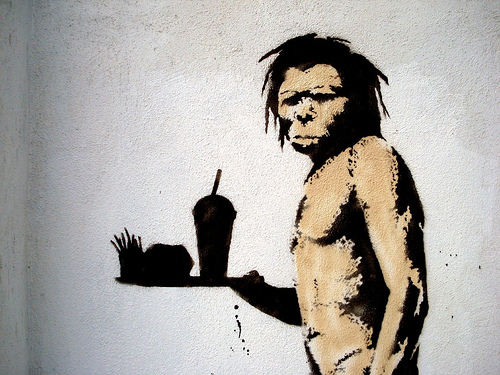
Now add the marketers and food makers. All making packaged foods that say Paleo. Well Paleo man aka Caveman didn’t have packaged foods. Mr. Caveman also didn’t have a car, TV, tablet, manufactured clothing or anything else that we enjoy in our modern lives. The Paleo community isn’t asking us to live like Paleo man just eat like him. So it’s natural that companies and entrepreneurs would try to offer modern convenient solutions, but let the buyer beware! Just because it says Paleo doesn’t mean it is and none of this is regulated by the FDA. Also, the FDA can’t keep up with all the food manufacturers and is relying on the to report misdeeds.
So it’s not just the regular grocery store where you have to monitor and read the labels, it’s also in the natural food stores including the big name guys. In fact, people tend to trust the brand name of the store and think they don’t have to read the labels. It’s just the opposite because small manufacturers have less oversight. The FDA only has so many inspectors to go around and so like everything else small guys get less attention. If Mom and Pop bakery messes up 1000s of people are affected, if Kraft has a problem millions are affected, so the FDA goes where the numbers are.
As you can see it’s very entertaining. As an interested outside observer, it dawned on me that the problem with Paleo is, that unlike Atkins, Weight Watchers and all the other national diets out there there’s no one or one company presenting a unified front on the message which has lead to the mass confusion.
It’s also the story of the internet. In the now mature public internet society, Paleo is the first “diet” or “lifestyle” that has grown solely out of many good folks having access to free websites. Anyone, who can figure out Word Press, can create a Paleo/caveman site and proselytize the goodness of Paleo. Paleo has become a phenomenon. When Paleo recipes showed up on the Today Show, observers knew you could put a fork in it, Paleo had become part of the national dialog.
So should you eat Paleo? Absolutely! You should eat organic. You should support local farmers. You should eat whole foods. You should limit processed foods to a bare minimum. You should be a wise shopper and decision maker. You should limit sugars and grains, in particular processed white flour and sugar. What do you think our national diabetic epidemic is all about?
Should you follow a Paleo Diet? I’m not convinced and which one would you follow anyway? Common sense and what works for you and your family should be your guide.
If you are looking for a good start even with their hiccups I would recommend . Dallas and Melissa Hartwig are transparent. and are also good resources not for necessarily Paleo but helpful whole food lifestyle tips. You’ll hear terms like low-carb high fat and primal on those sites but let’s save that for another time. (Disclaimer: I don’t know everything on the topic and I am not a doctor. I don’t even play one on TV.)